
Inverted and flat nipples are relatively common, and there are varying degrees of nipple inversion. Some nipples are permanently inverted, while others can be encouraged to protrude with cold, stimulation, or gentle pressure.
For some women, inverted nipples can cause difficulties with breastfeeding. For others, the concern is primarily cosmetic – many women simply feel uncomfortable with how their nipples look.
Importantly, while inverted nipples can be treated, there is no effective medical or surgical treatment for flat nipples.
Inverted nipples
It is important to distinguish flat nipples from inverted nipples. An inverted nipple is a nipple that is pulled inward toward the breast instead of projecting outward. This happens because the tissue beneath the nipple – often the milk ducts or fibrous bands – is shorter or tighter than usual, tethering the nipple inward.
Inverted nipples can vary from mild to severe. Nipple inversion is commonly classified into three grades, based on how easily the nipple can be brought out and whether it stays out.

Flat nipples
A flat nipple is a nipple that does not protrude above the surface of the areola, even when stimulated by cold, touch, or gentle pressure. Unlike an inverted nipple, a flat nipple is not pulled inward – it simply lacks projection.
Flat nipples may be present from birth or develop over time and can affect one or both breasts. They are a normal anatomical variation and are not a medical problem. Dr Tomlinson does not offer surgery for flat nipples.
How flat nipples differ from inverted nipples
Flat nipples sit level with the areola and do not evert because there is little or no projecting nipple tissue.
Inverted nipples are tethered inward by shortened ducts or fibrous tissue and can sometimes be pulled out.
This distinction is important because treatments that work for inverted nipples (such as suction devices or surgery) do not create projection in naturally flat nipples. Most women with flat nipples:
Have no health concerns related to nipple shape
May or may not have difficulty breastfeeding (many breastfeed successfully)
Breastfeeding challenges, when they occur, are usually related to latch mechanics rather than nipple shape alone, and lactation support can often help.
⚠️ Important Warning
If one or both nipples have recently become inverted, you should see your GP urgently, as this can be a sign of underlying breast disease, including breast cancer.
Your GP will examine your breasts and will usually arrange further investigations such as ultrasound and mammography, and referral to a breast specialist if required. Changes in nipple inversion should always be investigated.
What grade is my inverted nipple?
Nipple inversion is commonly classified into three grades, based on how easily the nipple can be brought out and whether it stays out. The grade of nipple inversion helps guide:
Whether non-surgical treatment is likely to work
Whether surgery is appropriate
The likelihood of preserving breastfeeding ability
Realistic expectations about outcomes
Research suggests that surgery will often improve the grade of nipple inversion by one grade. The results of surgery are not expected to transform a grade three inverted nipple into a nipple that is usually everted and behaves like a “normal” nipple in response to pressure, cold or stimulation.
It is also important to note that new or sudden nipple inversion, particularly if it affects only one nipple, should always be assessed by your GP to exclude underlying breast disease, including breast cancer.
Grade 1 nipple inversion (mild)
The nipple is usually inverted but can be easily drawn out with gentle pressure, cold, or stimulation.
Once everted, it remains projected for some time.
Milk ducts are typically intact and flexible.
Breastfeeding is usually possible.
This grade responds very well to non-surgical treatments, such as suction devices (e.g. Niplette).
Grade 2 nipple inversion (moderate)
The nipple can be pulled out with traction but tends to retract again once released.
There is moderate tethering of the milk ducts and surrounding tissue.
Breastfeeding may be more difficult but is sometimes possible.
May respond to non-surgical treatment, although success is less predictable than in Grade 1.
Surgical correction may be considered if non-surgical measures are unsuccessful.
Grade 3 nipple inversion (severe)
The nipple is permanently inverted and cannot be everted with gentle or moderate traction.
There is significant shortening and fibrosis of the milk ducts and supporting tissue.
Breastfeeding is usually not possible.
Non-surgical treatments are unlikely to be effective.
Surgical correction is often required to achieve lasting eversion, and this may involve division of milk ducts.
Treatment of inverted nipples
Can Inverted Nipples Be Treated Without Surgery?
Yes — many women do not require surgery.
In cases of mild to moderate nipple inversion, non-surgical treatment using a discreet suction device is often very effective. These devices are available without prescription from pharmacies or online.
Nipple suction devices
Nipple suction devices (sometimes also called “nipple aspirators”) are widely used and highly effective for treating inverted nipples. The Avent Niplette device, developed by a UK plastic surgeon, has unfortunately been discontinued, but alternative options are available online and can be purchased as a single or twin set, depending on whether one or both nipples are affected.
Nipple suction devices work best for grade 1 or 2 nipple inversion. This means it works best for nipples that:
Can be drawn out with gentle pressure or stimulation
Are not severely tethered or fixed in an inverted position
Women with severely inverted (grade 3) nipples that cannot be everted with moderate traction are less likely to achieve success with non-surgical treatment alone.
When Is Surgery Considered?
Dr Tomlinson recommends surgery only when non-surgical treatments have been unsuccessful.
The surgical approach depends on the severity of inversion. Wherever possible, techniques are used that preserve the milk ducts. However, in severe cases, division of the milk ducts may be required to achieve lasting correction. For this reason, many surgeons recommend that surgery be delayed until after child bearing and breastfeeding has been completed.
Dr Tomlinson will only divide milk ducts with your explicit consent and has a policy of performing duct-dividing procedures only in women who have completed their families.
Will I be able to breastfeed after surgery?
This depends on:
The type of surgical technique used
Healing and scarring after surgery
The most commonly used technique preserves the milk ducts, so breastfeeding is often still possible, but this cannot be guaranteed. It is important to note that some women are unable to breastfeed regardless of surgery. Mastitis may occur during breastfeeding regardless of surgery.
What are the risks of surgery?
As with any procedure, surgery carries risks. These include:
Bruising and discomfort
Scar sensitivity
Changes in nipple sensation (often increased sensitivity after correction)
Incomplete correction or recurrence of inversion
Dissatisfaction with outcome
Rarely, compromise to the blood supply of the nipple (nipple necrosis)
Serious complications are uncommon, and techniques are used to minimise risk.
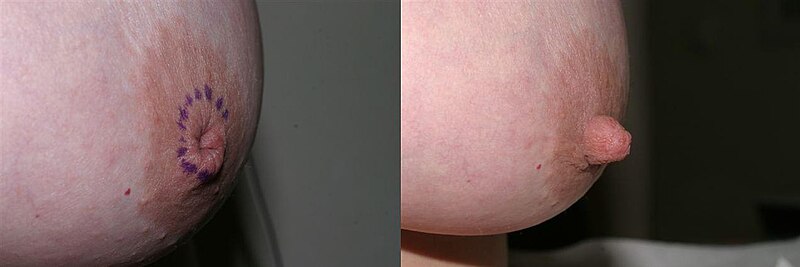
What will the result look like?
The degree of eversion, projection or protrusion of your nipple after surgery is heavily influenced by the starting point (grade) of nipple.
Improvement of one grade of nipple eversion is a realistic expectation, although this may not be achieved in all patients.
Dr Tomlinson frequently recommends the use of a nipple suction device for a minimum of six weeks after surgery to improve the results and outcomes of surgery. Post operative use of a nipple suction device can help
- Improve long-term projection
- Stretch milk ducts further
- Enhance symmetry if one nipple was more severely inverted
The incision is placed just below the nipple, within the areola. The position allows the natural shadow of the nipple to conceal the scar in most patients.
What is the cost of surgery?
The total out-of-pocket cost varies depending on:
Where the procedure is performed
Type of anaesthetic
Private health insurance cover
As a guide, the approximate out-of-pocket cost for bilateral nipple inversion correction as a rooms procedure with Dr Tomlinson is around $1,900. Patients are routinely advised to purchase a nipple aspirator device to optimise surgical results.
Any surgical or invasive procedure carries risks.
Before proceeding, you should seek a second opinion from an appropriately qualified health practitioner.